
Palmetto Bay Lookup Record Paths
No single roll answers every question about one person. A resident lookup should match the source to the fact. Property records establish ownership, not every occupant. Court indexes identify parties in public cases, not guilt or a full personal history. Vital certificates have separate access rules. Business and license filings may tie a name to a dated address, but that address can belong to an office or registered agent.
| Record | What it confirms | Where | Access |
|---|---|---|---|
| Property roll | Owner, situs, mailing address, parcel history | Miami-Dade Property Search | Free |
| Official record | Deed parties, date, legal description | County Recorder | Free index |
| Court docket | Party role, case events, public disposition | Miami-Dade Clerk | Index and counter |
| Vital record | Birth, death, marriage, divorce event | Florida DOH or Clerk | Rules vary |
| Business or license | Officer, agent, credential, filed address | Sunbiz or DBPR | Free |
| Probate | Decedent and public case parties | Miami-Dade Clerk | Public unless protected |
Use the most exact identifier first. A folio, case number, license number, or document CFN is safer than a name alone. When only a name is known, keep all candidate results and eliminate mismatches with dates, co-parties, addresses, and legal descriptions. This prevents a Palmetto Bay resident lookup from blending separate people.
Palmetto Bay Court Name Lookup
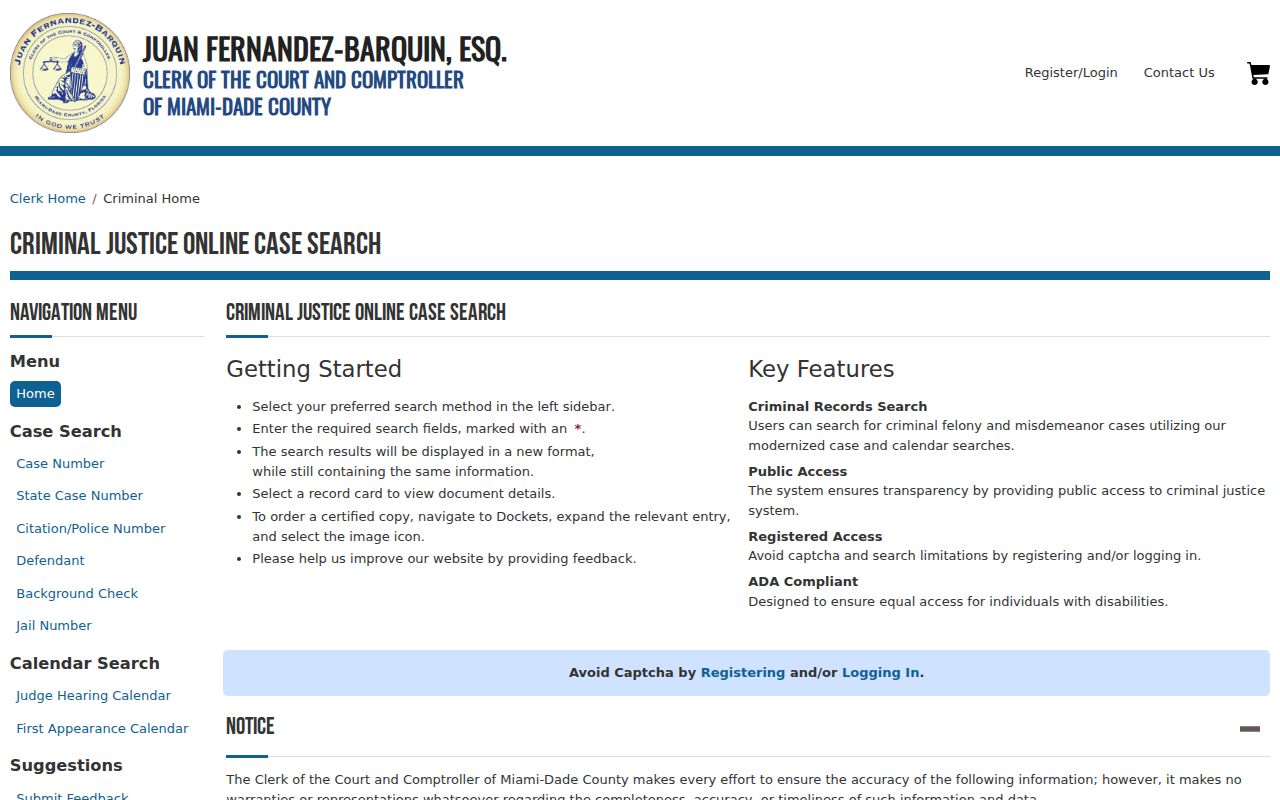
The Eleventh Judicial Circuit serves Palmetto Bay. The Miami-Dade Clerk separates civil, family, and probate searches from criminal searches. Civil users can search by party name, local case number, state case number, or hearing date. Criminal users can search by case number, citation or police number, defendant name, jail number, or judge and calendar date. Sealed, adoption, juvenile, and expunged matters do not appear as ordinary public results.
| Field | Best use | Result clue |
|---|---|---|
| Party name | Test surname and given-name variants | Role and case style |
| Case number | Retrieve an exact matter | Division, status, activity |
| Hearing date | Find a calendar entry | Judge and event |
| Citation, police, or jail number | Narrow criminal records | Defendant and case events |
A public result may show filing date, case type, parties, lawyers, judge, docket events, and disposition. The Florida public docket resource appears below.
For county criminal matters, use Criminal Justice Online. Its screen is an index rather than the whole file.
Certified copies come from the Clerk. Older or unscanned files may require a public terminal, a counter visit, or a call to 305-275-1155 with the case number.
Federal Palmetto Bay Resident Records
Federal cases fall outside county portals. The Southern District of Florida uses CM/ECF, while PACER can search federal courts by party, court, case number, and filing date. PACER requires an account. Research documented a charge of $0.10 per page, generally capped at $3 per document, with quarterly fees waived below the published threshold.
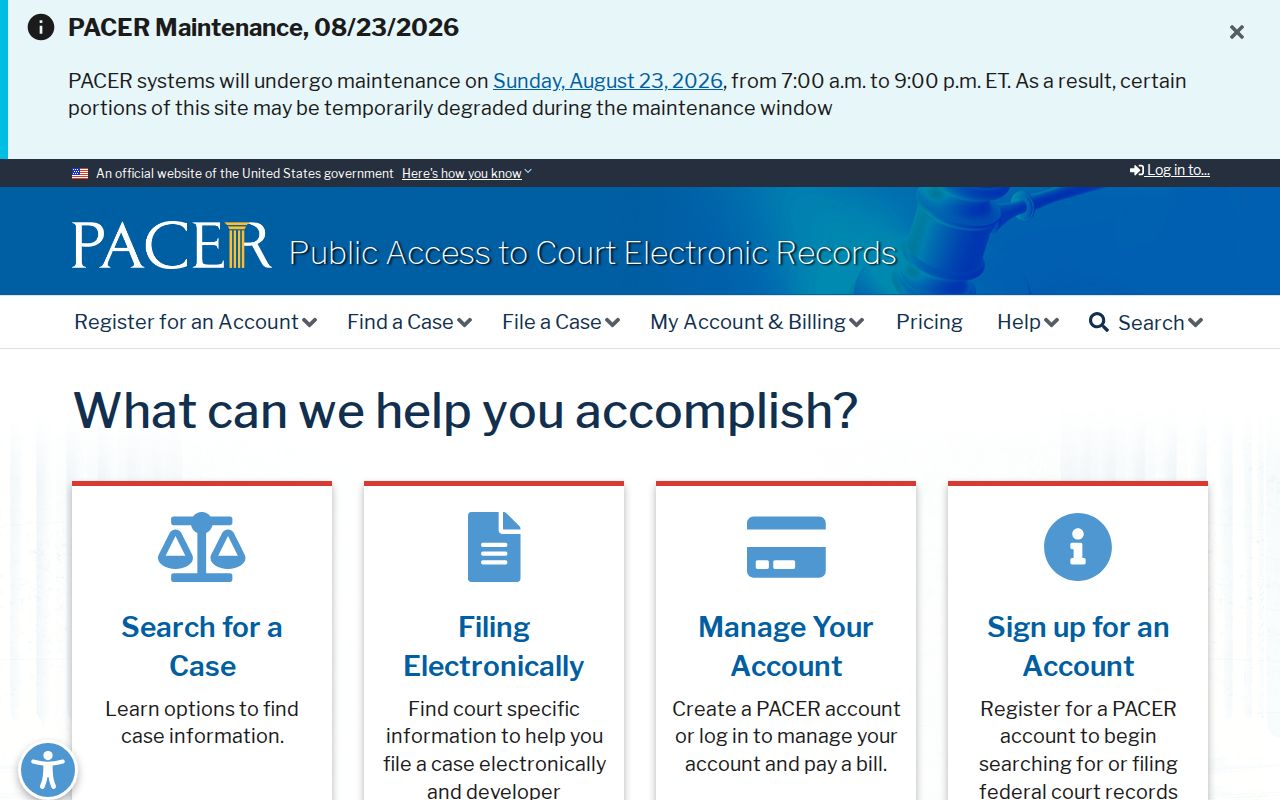
The official PACER gateway is shown here. Results may contain parties, lawyers, docket entries, and public PDFs.
Match a filing to a middle name, business, date, or address. County and surname alone are not enough.
Verify Palmetto Bay Resident Records
Verification needs two points that agree. Palmetto Bay's diverse name patterns make variant searches useful. Test compound surnames, two family names, accents, spaces, hyphens, married names, maiden names, and Anglicized forms. Preserve each custodian's spelling.
- Search the Miami-Dade Property Search by owner or address. Record folio, situs, mailing address, and sale.
- Use the name in the Recorder or court index. Compare dates, co-parties, CFN, case number, and legal description.
- Check a separate source such as a marriage index, Sunbiz filing, or DBPR license. A business address is only a dated link.
- Order a certified copy when authentication matters. Certification does not prove each claim inside is true.
- Docket
- The dated list of filings and events in a case.
- Index versus image
- An index summarizes fields; an image reproduces the filed record.
- Certified copy
- A copy authenticated by its custodian.
Note: Save the URL, terms, inspection date, and identifier so another person can repeat the Palmetto Bay lookup.
Palmetto Bay Vital Record Limits
Florida vital records separate searchable events from protected certificates. Birth certificates become public 125 years after birth. Before then, access is limited to the adult registrant, a named parent, documented guardian or representative, or someone authorized by court order. Death records without cause are more open, but cause stays confidential for 50 years except to qualified relatives and representatives.
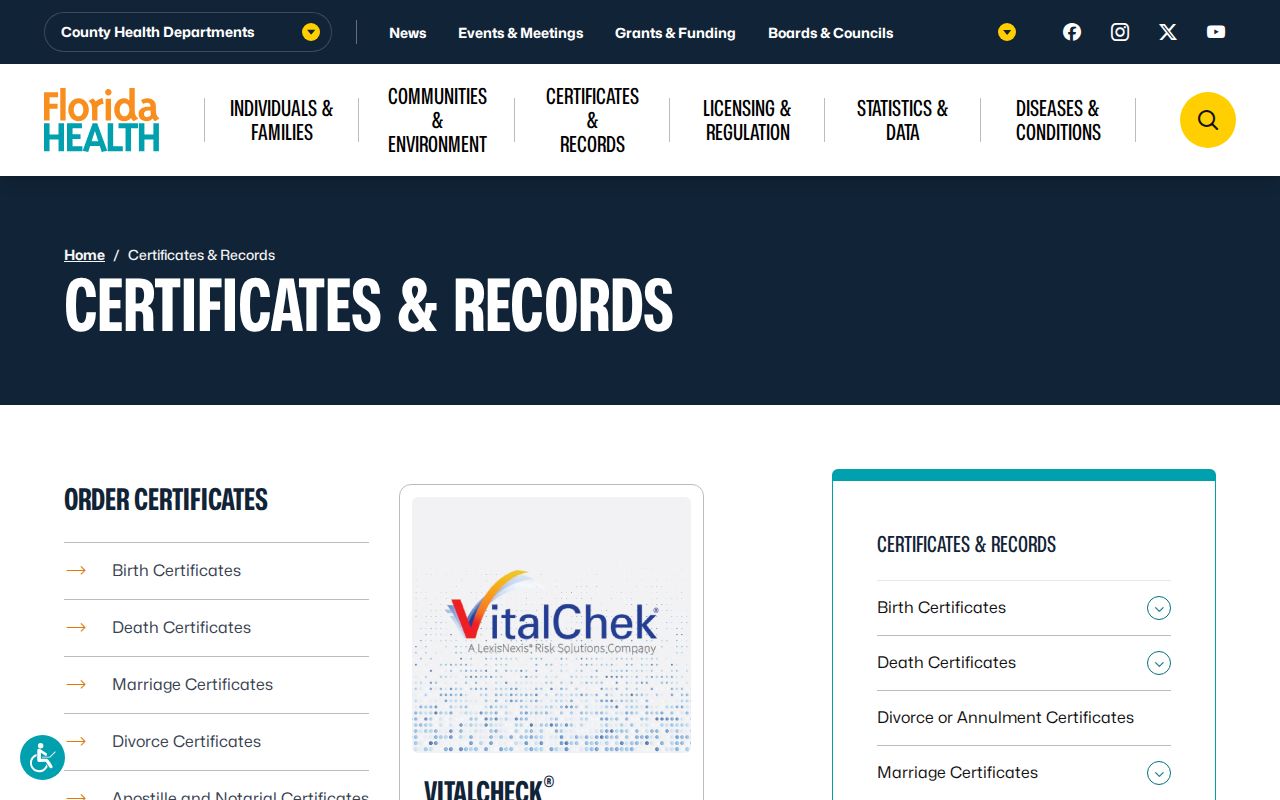
The Florida certificates gateway routes birth, death, marriage, and divorce orders.
Miami-Dade's Clerk holds marriage licenses and divorce files. State marriage and divorce abstracts start June 6, 1927. A divorce certificate is not the full judgment, so request the decree from the Clerk.
Palmetto Bay Family Connections
Some searches need a narrow route. To locate an heir, search probate by decedent, review the public petition and personal representative, then confirm with a deed and obituary. Do not assume every relative inherited. To reconnect with a classmate, start with school and graduation year, then ask MDPLS or HistoryMiami for yearbooks and public newspaper archives.
A probate caption may identify the estate, but the docket shows how the matter moved. Read the petition, notices, orders, and recorded transfers that are open to the public. Compare a former owner's legal description with the current parcel so a same-name filing does not get attached to the wrong house. The Miami-Dade obituary index can supply a death date and family names, while a cemetery or funeral-home notice may provide another dated lead. These sources support family research, yet none should be used to expose a protected address.
Yearbooks and alumni publications work differently. Search by school name and class year, then test nicknames, initials, married surnames, and the spelling used at graduation. The Miami-Dade Public Library System's Main Library has genealogy staff, city directories, telephone books, census sources, and a large microform collection. HistoryMiami holds photographs, manuscripts, maps, and subject files for Dade County communities. Ask each institution about access and copying because private membership rosters are not public merely because an organization exists.
Adoption files are confidential. A birth parent or adoptee should use Florida's official Adoption Reunion Registry and an authorized court or intermediary process. A resident lookup must stop where the official channel closes. That limit is part of an accurate search, not a dead end to bypass through unrelated databases.
Request Missing Palmetto Bay Records
An online nonmatch does not prove that a record or person is absent. Spelling may differ, the file may predate imaging, or law may withhold it. Florida Public Records Law permits a focused request to the custodian. State the record type, date span, address, folio, case, or CFN and ask for electronic delivery.
Miami-Dade accepts requests through its public records request portal. Police reports for Palmetto Bay route to Miami-Dade Police because policing is contracted.
If a file no longer exists, ask for the index or retention schedule. “Not found” describes that office's search, not the person.
Legal Limits on Palmetto Bay Lookups
Florida shields sealed cases, voter identity numbers and signatures, protected officials, and Address Confidentiality Program participants. Do not combine portals to rebuild an address that an agency redacted. Corrections belong with the custodian: ownership with the Property Appraiser after checking the deed, court entries with the Clerk, voter errors with Elections, and credentials with the issuing regulator.
A private compilation can lag official updates. Confirm each key fact at its source. The Florida Digital Bill of Rights is limited in scope and does not erase valid public deeds or assessments.
When the search involves a protected address, note only that the public record is withheld. Florida's Address Confidentiality Program provides a substitute mailing address to eligible survivors of domestic violence, stalking, aggravated stalking, human trafficking, and related harms. Certification is free, lasts four years, and requires a sworn safety basis. A searcher must not treat the substitute address as a data error or use other indexes to uncover the confidential residence.
Public-record exemptions also cover specified officials and family members. Voter files withhold Social Security numbers, driver-license or state-ID numbers, signatures, and protected-address information. Motor-vehicle personal data is governed by the federal Driver's Privacy Protection Act. These limits explain why an official resident lookup may return less than a private compilation. The official result is still the safer source because it reflects the custodian's current disclosure rules.
Correction follows the record's chain of custody. If Property Search shows the wrong owner, compare the recorded deed before contacting the Property Appraiser. If a court index contains an error, give the Clerk the exact case number and docket entry. A vital certificate amendment goes through the Florida Department of Health process, while a voter record correction goes to Elections. Save the request, response date, and any replacement document so the change can be verified later.
A public index also has limits of time and format. A deed image may contain facts that the index omits. An older court file may exist only at a terminal or counter. A state vital-record search may confirm an event while the certificate remains restricted. The best Palmetto Bay resident lookup records both the positive match and the access channel used, including a mail request, telephone inquiry, office visit, or certified-copy order when the web screen is incomplete.
Lawful use. Use a Palmetto Bay resident lookup only for lawful personal research. Florida law forbids stalking, harassment, threats, and harm.