
Finding Palmetto Bay Residents
Finding one person in Palmetto Bay starts with the fact already known. An exact street address belongs in the county property roll. A full name belongs in owner, court, business, and license indexes. A past address needs the deed chain, library directories, census schedules, and probate records. Each source answers a narrow question, so a match becomes reliable only when two independent details agree.
Ownership is not the same as occupancy. The Property Appraiser may name an owner and show a different tax-mailing address, while renters and other household members remain absent. A court party name proves involvement in a public case, not residence. The Palmetto Bay residents directory works as a path among custodians, not as one master roster.
- Search the Miami-Dade property roll by an address or owner name and record the folio.
- Compare situs, which means the physical parcel, with the tax-mailing address.
- Search the Recorder or court index using exact names, variants, and record numbers.
- Check a second official source such as voter status, a state filing, or a vital index.
- Ask the correct custodian for older, unscanned, or narrowly described material.
Palmetto Bay Directory Custodians
Palmetto Bay incorporated in 2002 and is not the county seat. Village Hall keeps Village-created records such as minutes, resolutions, zoning, permits, code matters, registrations, and local public-record requests. Miami-Dade County holds the core land, assessment, trial-court, marriage-license, voter, and police files. Florida agencies keep certified vital records, corporations, professional licenses, and statewide custody data.
The Village Clerk is the local records custodian, but Palmetto Bay police files route to Miami-Dade Police because the Village contracts for policing. That split saves time: identify who made the record before sending a request.
Palmetto Bay Property Roll Search
The Miami-Dade Property Search is the strongest first stop for an address or owner. Its basic screen accepts address, an optional suite, owner name, subdivision name, or a 13-digit folio. Search name order and spelling variants when a person does not appear on the first try. For an address, retain the SW prefix and distinguish a numbered street from a numbered avenue.
| Portal field | Input | Use in a resident search |
|---|---|---|
| Address | Street number and name | Find the situs parcel |
| Suite | Unit or suite | Narrow multi-unit results |
| Owner Name | Person or entity | Find owned parcels |
| Subdivision | Recorded subdivision name | Connect lots and plats |
| Folio | 13-digit identifier | Join county systems |
A parcel card can show owner, mailing and situs addresses, municipality, legal description, values, sales, exemptions, building facts, and links to maps and taxes. The roll changes over time and is not a title opinion. Homestead is an owner-occupancy clue for a tax year, never a full list of people in a home.
Palmetto Bay's Folio Record Key
The folio is the safest bridge among the parcel card, GIS, deeds, taxes, permits, and legal description. Names change. Addresses can be standardized. A folio stays tied to the parcel until a division or combination changes it. Record it before moving to another portal, and pair it with subdivision, lot, block, and plat book/page.
Mailing and situs addresses deserve separate notes. Situs identifies the taxed land. The owner mailing address receives tax correspondence and may be another home, an office, or a post-office box. If the two differ, do not label the owner an absentee without more proof. The Palmetto Bay street directory carries the full address-to-folio-to-deed method.
- Parcel
- A defined piece of land tracked for assessment.
- Folio
- Miami-Dade's 13-digit parcel identifier.
- Index
- A searchable list that points to a source record or image.
- Roll
- An official list compiled for a government purpose, such as assessment.
Current Palmetto Bay Resident Sources
Modern directory-like sources cover different groups. The owner roll misses renters. The voter self-lookup confirms one supplied identity rather than opening a street roster. Deeds list parties to recorded instruments. Court, corporation, license, and custody systems cover only people connected to those record types. Read the limits before treating a name as evidence of residence.
| Source | People or parties included | Keeper | Access |
|---|---|---|---|
| Property roll | Parcel owners | Property Appraiser | Free portal |
| Voter status | Matching registered voter | Florida Elections | Protected inputs |
| Official records | Deed, lien, and other instrument parties | County Recorder | Free ordinary index |
| Court dockets | Parties in public cases | Miami-Dade Clerk | Public index |
| Business and licenses | Filed officers, agents, licensees | Sunbiz and regulators | Free indexes |
The best first source depends on the question. Use an address for the property roll, a case number for court, a corporation name for Sunbiz, and an exact credential for DBPR. The Palmetto Bay resident lookup explains how to verify one name across these indexes.
Palmetto Bay Voter Lookup Limits
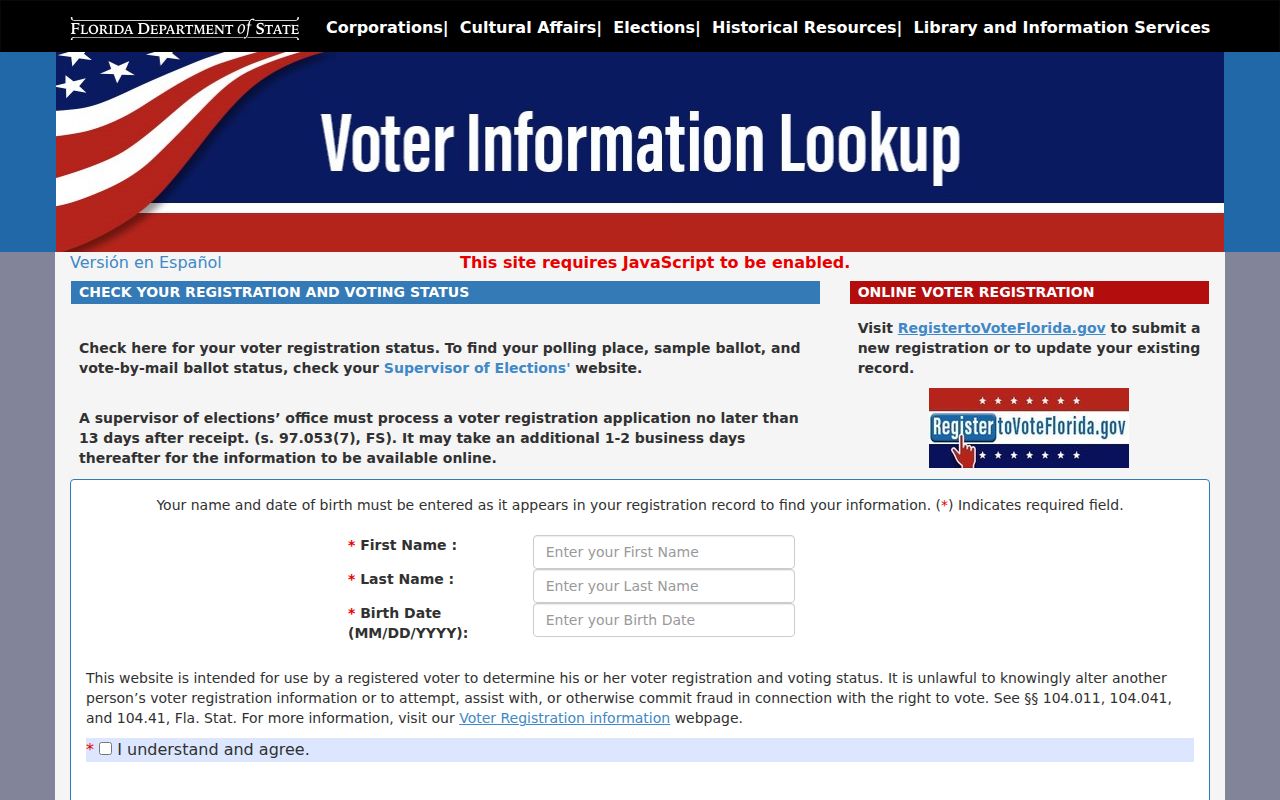
The Florida Voter Information Lookup asks for first name, last name, date of birth, and county. A match may show status, party, precinct, districts, vote-by-mail status, and participation history. Participation states whether someone voted in an election. It never discloses the ballot choice. The official tool is personal verification, not a searchable residents directory by street.
The Florida voter lookup is shown below. The form's identity fields explain why it cannot be used as an open browse tool.
Florida law keeps Social Security numbers, driver-license or state-ID numbers, and voter signatures confidential. Protected addresses may also be withheld. Miami-Dade Elections handles voter-data and archived-registration requests, but bulk data remains subject to exemptions, current procedures, and possible quoted costs.
Palmetto Bay Deeds Before 1974
The Recorder's ordinary online coverage is most complete from 1974 forward. Earlier deeds did not vanish. They move to the Miami-Dade Records Library, its indexes, public computers, books, and staff search process. Search surname first, then use subdivision, lot, block, plat, or a known book and page. Research documented a staff search charge of $2 per name per year for older work.
A current deed names a grantee, the buyer receiving an interest, and a grantor, the person conveying it. To work backward, find the current owner's acquisition deed, verify the legal description, then search that seller as an earlier buyer. Names alone are unsafe. Repeated legal-description details and document identifiers keep the chain on the same land.
Online copies are $1 per page, with $2 certification when needed. A certified copy proves that the office authenticated the copy, not that each claim inside the deed is correct. For complex title questions, use legal help rather than treating the residents directory as a title report.
Palmetto Bay Court Party Records
Palmetto Bay cases fall within Florida's Eleventh Judicial Circuit. Miami-Dade separates civil, family, and probate searching from criminal justice. County fields include party name, local or state case number, hearing date, defendant name, citation or police number, jail number, and criminal calendar searches. A result may display party roles, case style, filing date, division, lawyers, judge, docket events, and public disposition.
An index is not the complete file. Documents may be absent, older material may not be scanned, and certified copies must come from the Clerk. Sealed, adoption, juvenile, and expunged matters are not ordinary public results. Public terminals and the records counter are the fallback for files that the web cannot deliver.
A same-name result needs two matching facts, such as an address and co-party, or a case number and filing date. Allegations in a complaint are not findings. This distinction keeps court searching useful without turning a public docket into a broad claim about a resident.
Palmetto Bay Vital Record Routes
Birth, death, marriage, and divorce records follow different paths. Florida DOH and the Miami-Dade health office issue qualifying vital copies. The Clerk keeps marriage-license and divorce case files. State marriage and dissolution abstracts begin June 6, 1927, while a divorce certificate is not the full judgment. Older church, cemetery, newspaper, census, and library sources can fill gaps before statewide registration.
Birth certificates become public 125 years after birth. Until then, the adult registrant, named parent, documented guardian or legal representative, or a court-authorized person may qualify. Death copies without cause are broadly available, but cause of death is protected for 50 years except for qualified family members, estate interests, representatives, or court orders.
Check the Florida certificates gateway for current forms and prices. A public index may confirm that an event occurred while the certificate remains restricted. Never try to defeat a protected adoption or vital-record rule with facts collected from unrelated portals.
Palmetto Bay License Connections
State filings can confirm a dated public connection for a name that appears elsewhere. Sunbiz searches entity names, officers, registered agents, document numbers, and fictitious names. Annual-report images may preserve prior officers and filed addresses. A registered agent can be a lawyer or service company, so it does not prove that person owns the company or lives at the filing address.
The Florida DBPR license search accepts name, license number, city or county, license type, and status. Its official interface appears below.
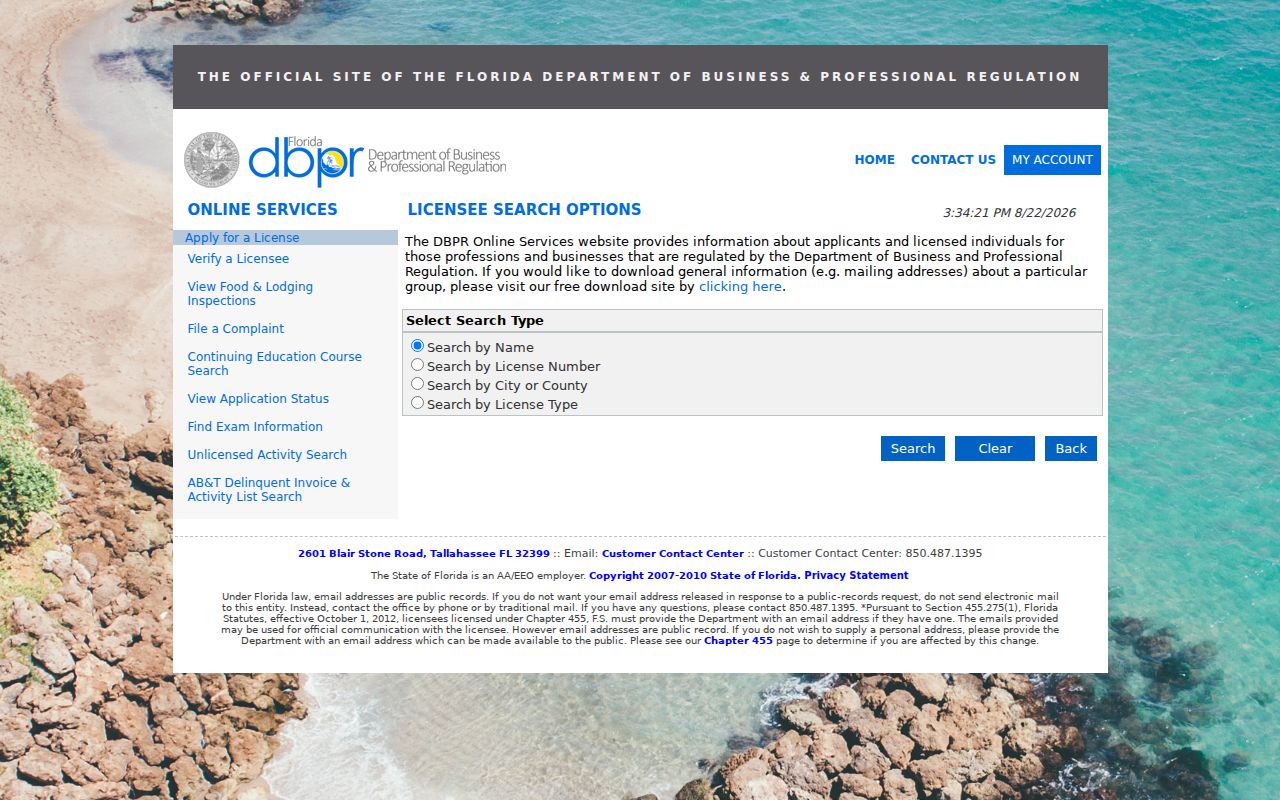
A public result can show a licensee or business, credential status, expiration, address, and discipline links where published. Use the license number as the match key. An office address confirms a filed professional connection, not a home address.
Official Palmetto Bay Directory Evidence
Commercial people-finding compilations mix public and purchased data. They may lag corrections, merge same-name people, or omit protected information inconsistently. An official custodian supplies a clearer record context, identifier, date, access rule, and correction path. That makes official sources better for genealogy, heir research, reconnecting, seller verification, and civic questions.
| Source type | Strength | Limit |
|---|---|---|
| Official index | Named custodian and record identifier | May omit images or protected fields |
| Certified copy | Authenticated by the custodian | Costs and eligibility may apply |
| Commercial compilation | Broad lead collection | Unverified, delayed, or conflated |
Corrections go to the office that owns the record. Assessment ownership errors belong with the Property Appraiser after checking the deed. Court entries go to the Clerk or court. Voter errors go to Miami-Dade Elections. Business and license errors go to the state agency that issued the filing.
Historical Palmetto Bay Resident Directories
Older Palmetto Bay research requires older place names. The Village did not exist as a municipal government before 2002, and Miami-Dade was called Dade County before 1997. Library and archive catalogs may classify local material under Miami, Perrine, Cutler, Peters, or South Dade. Those terms are essential search keys for directories, maps, newspapers, photographs, and census records.
Miami-Dade Public Library System's genealogy holdings exceed 27,000 books and 35,000 microforms. The Main Library provides genealogy help, databases, local materials, and the Miami-Dade Obituary Index. HistoryMiami adds manuscripts, photographs, maps, ephemera, and community subject files. Exact South Dade city-directory years should be confirmed with staff instead of guessed.
A criss-cross directory organizes entries by street or phone rather than surname. It can connect an address with a listed householder in a given year, but coverage may omit renters, unlisted numbers, and outlying areas. The full shelf method belongs in the historical city directory section of the site.
Palmetto Bay's Earlier Place Names
Palmetto Bay's modern name can hide its older record trail. The Perrine Land Grant, Town of Peters, Old Cutler Road, and Deering Estate at Cutler are useful catalog phrases from the Village's fourteen-stop historical tour. Pair each historic term with the modern parcel, folio, and legal description. This prevents an older photograph, map, or directory entry from becoming detached from its present location.
Federal census schedules are public through 1950 under the 72-year rule. Florida's 1935 and 1945 state censuses help between federal years. Directories can bridge the years between censuses, while deeds establish ownership and permits help date construction or alterations. No source alone proves every occupant, so note whether each item describes land, an owner, or an enumerated household.
Lawful Palmetto Bay Records Access
Florida Public Records Law generally allows any person to request an open record without stating a purpose, presenting identification, or using a mandatory written form. A precise written request can still help. Name the custodian, record type, date range, address, folio, case number, or CFN, and ask for electronic delivery. If the file is gone, ask for its index or retention schedule.
Openness has firm limits. Address Confidentiality Program participants use substitute addresses. Voter identifiers, sealed court files, juvenile matters, protected vital records, and specified officials' information remain confidential. Do not reconstruct a redacted location by joining other databases.
Lawful use. Use the Palmetto Bay residents directory for lawful personal research. Florida law forbids stalking, cyberstalking, harassment, threats, and harm.
The Village's public-request archive can reveal that a topic was requested before and may link a responsive package. Treat it as a finding aid. Make a fresh request when the old response is incomplete, stale, or lacks an attachment, and cite the agency record rather than a prior requester's summary.
Palmetto Bay Custody Search Context
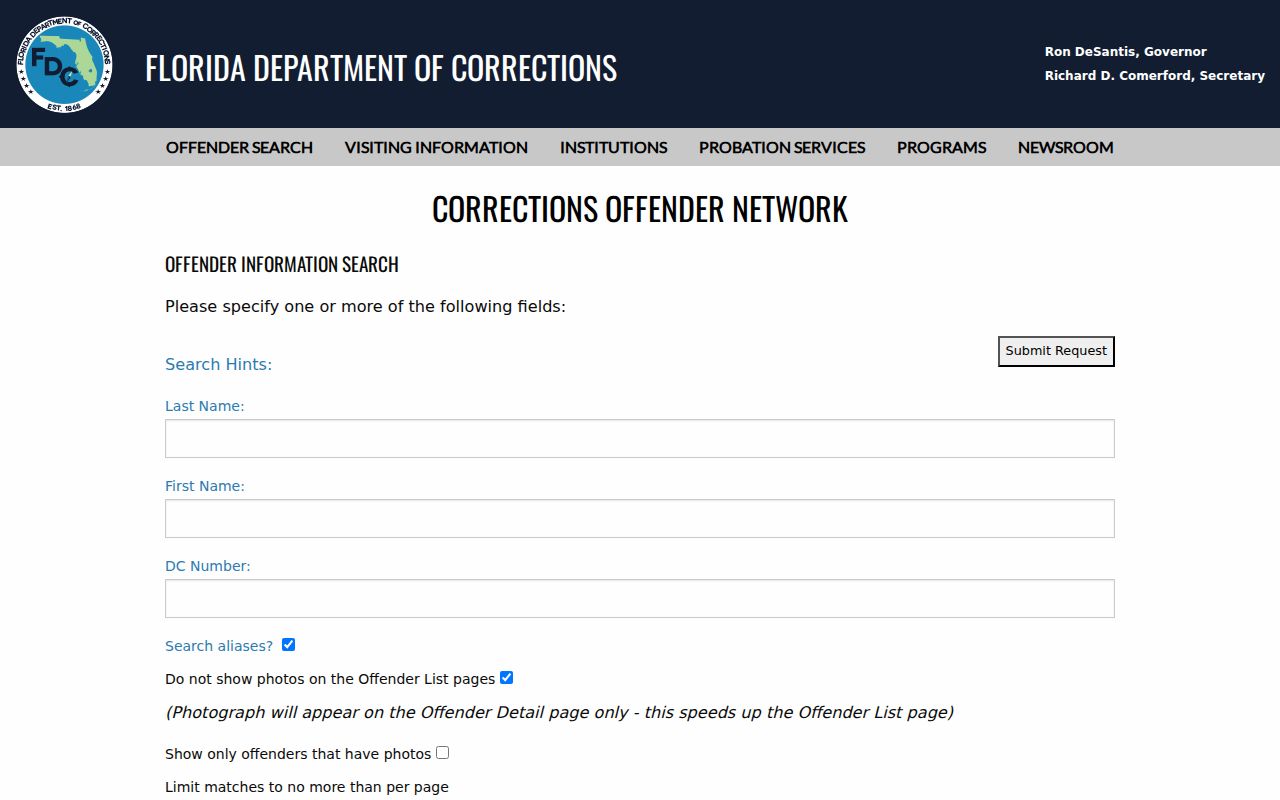
Custody systems are narrow public-safety indexes, not resident rolls. The Florida Department of Corrections search covers current, released, supervised, absconded, escaped, and other defined populations. Public results may show identity, photo, DC number, status, offense, sentence, location, and supervision information. Verify the current status and read statutory warnings before using a result.
The official Florida corrections search is shown below. Its fields include last name, first name, DC number, alias options, and result display controls.
Miami-Dade's current inmate search is separate and reflects present county custody, not a historical Palmetto Bay directory. A custody record never authorizes harassment. For a nonmatch, do not infer that no prior case or supervision record exists.